How PanorAi executes computer vision on spherical images
Surface |
Stability |
Canonical import |
Contract |
Public components or entries |
|---|---|---|---|---|
spherical-features-core |
Stable |
panorai.features |
panorai-spherical-features/v1 |
DeduplicationResult, FaceSetSpec, FeatureExtractor, FeatureExtractorConfig, FeatureMatcher, FeatureMatcherConfig, FeatureProvenance, FaceDetectionDiagnostics, MatchProvenance, MultifaceDetectionDiagnostics, OpenCVFeatureBackend, SphericalBearingCorrespondences, SphericalFeature, SphericalFeatureMatches, SphericalFeaturePipeline, SphericalFeaturePipelineConfig, SphericalFeatureSet, available_presets, deduplicate_spherical_keypoints, extract_opencv_features, gnomonic_feature_mask, match_opencv_features, panorai.features.backends.OpenCVFeatureBackend |
spherical-features-pycolmap |
Experimental |
panorai.features |
panorai-spherical-features-pycolmap/v1 |
GnomonicRig, GnomonicRigCamera, PyCOLMAPExportResult |
spherical-features-multiscale |
Experimental |
panorai.features |
panorai-spherical-features-multiscale/v1 |
MultiscaleEmbeddingConfig, MultiscaleFeatureMatches, MultiscaleFeatureSet, MultiscaleSphericalFeaturePipeline, OpenCVContextEmbedding, VisualContextNode, VisualEmbeddingProvider |
spherical-features-dog-sift |
Experimental |
panorai.features |
panorai-spherical-dog-sift/v2 |
SphericalDoGSIFTConfig, SphericalDoGSIFTExtractor, SphericalDoGSIFTPipeline |
spherical-features-dog-detector |
Experimental |
panorai.features |
panorai-spherical-dog-detector/v2 |
SphericalDetectionDiagnostics, SphericalDoGDetector, SphericalDoGDetectorConfig, SphericalKeypoint, SphericalKeypointSet, SphericalOctaveDetectionDiagnostics, SphericalRefinedKeypoint |
spherical-features-coarse-dog-detector |
Experimental |
panorai.features |
panorai-spherical-coarse-dog-detector/v1 |
SphericalCoarseDoGDetector, SphericalCoarseDoGDetectorConfig |
spherical-features-tangent-patches |
Experimental |
panorai.features |
panorai-tangent-patches/v1 |
OpenCVTangentDescriptor, OpenCVTangentDescriptorConfig, TangentDescriptorSet, TangentPatch, TangentPatchGeometry, TangentPatchProvider, TangentPatchRequest, TangentPatchSet |
spherical-feature-resolution-selection |
Experimental |
panorai.features |
panorai-resolution-selection/v1 |
ResolutionLevelReport, ResolutionSelectionObservation, ResolutionSelectionPolicy, ResolutionSelectionReport, ResolutionTransitionReport, select_feature_resolution |
spherical-features-tangent-descriptor-v2 |
Experimental |
panorai.features |
panorai-tangent-opencv-descriptor/v2 |
OpenCVTangentDescriptorV2, OpenCVTangentDescriptorV2Config, TangentDescriptorHypothesisSet |
spherical-relative-pose-pipeline |
Experimental |
panorai.features |
panorai-spherical-relative-pose-pipeline/v1-experimental |
ExtractSphericalFeaturePair, MatchSphericalFeatures, SphericalFeaturePair, SphericalImagePair, ToBearingCorrespondences |
spherical-deep-learning-depth |
Experimental |
panorai.experimental.deep_learning |
panorai-spherical-metric-depth/v1-experimental |
SphericalMetric3D, acquire_metric3d_convnext_large_v1, acquire_metric3d_convnext_tiny_v1, load_spherical_metric3d_convnext_large_v1, load_spherical_metric3d_convnext_tiny_v1, panorai.depth.DepthAdapterUnavailableError, panorai.depth.ModelRegistry, panorai.depth.load_dav2_model, panorai.depth.load_dust3r_model, panorai.depth.load_m3dv2_model, panorai.depth.load_zoe_model, panorai.depth.zoe.load_zoe_model, panorai.experimental.deep_learning.depth.SPHERICAL_METRIC_DEPTH_INTERFACE, panorai.experimental.deep_learning.depth.METRIC3D_CHECKPOINT_REVISION, panorai.experimental.deep_learning.depth.METRIC3D_CONVNEXT_LARGE_V1, panorai.experimental.deep_learning.depth.METRIC3D_CONVNEXT_TINY_V1, panorai.experimental.deep_learning.depth.METRIC3D_SOURCE, panorai.experimental.deep_learning.depth.METRIC3D_SOURCE_COMMIT, panorai.experimental.deep_learning.depth.ExternalArtifactRecord, panorai.experimental.deep_learning.depth.ExternalArtifactSpec, panorai.experimental.deep_learning.depth.LoadedSphericalDepthModel, panorai.experimental.deep_learning.depth.Metric3DAssets, panorai.experimental.deep_learning.depth.SphericalMetric3D, panorai.experimental.deep_learning.depth.UpstreamTermsNotAcceptedError, panorai.experimental.deep_learning.depth.acquire_metric3d_convnext_large_v1, panorai.experimental.deep_learning.depth.acquire_metric3d_convnext_tiny_v1, panorai.experimental.deep_learning.depth.load_spherical_metric3d_convnext_large_v1, panorai.experimental.deep_learning.depth.load_spherical_metric3d_convnext_tiny_v1 |
tangent-da3-metric-depth |
Experimental |
panorai.experimental.deep_learning |
panorai-depth-anything-3-metric-tangent/v1-experimental |
DA3MetricTangent, acquire_da3metric_large, load_da3metric_large, panorai.experimental.deep_learning.da3.DA3Assets, panorai.experimental.deep_learning.da3.DA3MetricTangent, panorai.experimental.deep_learning.da3.DA3TermsNotAcceptedError, panorai.experimental.deep_learning.da3.DA3_CANONICAL_FOCAL_PX, panorai.experimental.deep_learning.da3.DA3_CHECKPOINT_REVISION, panorai.experimental.deep_learning.da3.DA3_MODEL_ID, panorai.experimental.deep_learning.da3.DA3_PATCH_SIZE, panorai.experimental.deep_learning.da3.DA3_SOURCE, panorai.experimental.deep_learning.da3.DA3_SOURCE_COMMIT, panorai.experimental.deep_learning.da3.DA3METRIC_LARGE, panorai.experimental.deep_learning.da3.LoadedDA3MetricModel, panorai.experimental.deep_learning.da3.SPHERICAL_DA3_METRIC_DEPTH_INTERFACE, panorai.experimental.deep_learning.da3.acquire_da3metric_large, panorai.experimental.deep_learning.da3.load_da3metric_large |
spherical-semantic-segmentation |
Experimental |
panorai.experimental.deep_learning.segmentation |
panorai-spherical-semantic-segmentation/v1 |
SPHERICAL_MASK_PROPOSALS_INTERFACE, SPHERICAL_PROXY_SEGMENTATION_INTERFACE, SPHERICAL_SEMANTIC_SEGMENTATION_INTERFACE, SAM21_HIERA_LARGE_LICENSE, SAM21_HIERA_LARGE_REPOSITORY, SAM21_HIERA_LARGE_REVISION, IMAGENET_PROXY_VOCABULARY, DenseSemanticEvidence, Sam21Assets, Sam21FileRecord, Sam21HieraLargeSegmenter, Sam21TermsNotAcceptedError, SamMultimaskOutput, SegmentPrompt, SemanticProxyConcept, SphericalBinaryMask, SphericalProxySegmenter, SphericalMaskProposal, SphericalMaskProposalSet, SphericalSeed, SphericalSegment, SphericalSegmentationConfig, SphericalSegmentationResult, SphericalSemanticSegmenter, acquire_sam21_hiera_large, advance_chart, backproject_face_mask_sets, angular_distance_degrees, backproject_face_masks, concept_display_names, concept_evidence_from_imagenet, concept_proxy_names, connected_component_at, consensus_frontiers, extract_mask_face, extract_rgb_face, face_point_direction, fibonacci_coverage_seeds, load_sam21_hiera_large, majority_and_envelope, mask_stability_score, maximum_pairwise_iou, merge_proposals, non_maximum_suppression, partition_proposals_by_origin, pairwise_mask_iou, prompt_from_mask, prompt_grid, proposal_is_accepted, resolve_panoptic_map, select_semantic_seeds, semantic_support_for_mask, solid_angle_weights, weighted_containment, weighted_intersection_over_union |
spherical-relative-pose |
Experimental |
panorai.estimators |
panorai-spherical-relative-pose/v1 |
CalibrationEvaluation, DecoupledPoseReport, EstimateRelativePose, FivePointSample, FivePointSampler, FivePointSamplingDiagnostics, ModelCompetitionReport, ModelEvidence, PoseStabilityReport, RelativePoseAcceptancePolicy, RelativePoseConfidenceCalibrator, RelativePoseOptions, RelativePoseQualityReport, RelativePoseResult, TranslationOrientationReport, SpatiallyWeightedFivePointSampler, SphericalRelativePoseEstimator, UniformFivePointSampler, estimate_relative_pose, native_kernels_available, solve_five_point_essential, spherical_tangent_sampson_error |
semantic-object-localization |
Experimental |
panorai.object_localization |
panorai-object-localization/v1 |
JOINT_MATCH_CLUSTERS_INTERFACE, JointMatchCluster, JointMatchClusterConfig, JointMatchClusterResult, MULTIVIEW_OBJECT_HYPOTHESES_INTERFACE, BearingTrackTriangulation, DirectionalRegionTransfer, HypothesisAffinity, HypothesisAffinityConfig, HypothesisGnomonicRegion, HypothesisPairCues, HypothesisReductionCandidate, HypothesisReductionResult, HypothesisRegionEvaluation, HypothesisTransferEvaluation, HypothesisViewConsistency, HypothesisViewEmbedding, HypothesisViewPairEvaluation, MultiviewObjectHypothesis, MultiviewObjectHypothesisResult, MultiviewSpatialRegion, OBJECT_LOCALIZATION_INTERFACE, OBJECT_LOCALIZATION_STABILITY, ObjectHypothesis, ObjectLocalizationConfig, ObjectLocalizationPipeline, ObjectLocalizationResult, PairObjectLocalizationInput, RegionAssociation, ReducedHypothesisRecord, RegisteredSemanticEvidence, RegisteredBearingObservation, RegisteredBearingTrack, RegisteredPoseInconsistencyError, RegisteredRadialDepth, SEMANTIC_MATCH_PRIOR_INTERFACE, SEMANTIC_REGION_PROPOSALS_INTERFACE, SPHERICAL_ANCHOR_FUSION_INTERFACE, SemanticMatchPrior, SemanticMatchPriorConfig, SemanticQuery, SemanticConcept, SemanticRegionProposalConfig, SemanticRegionProposalResult, SemanticRegionObservation, SemanticTrackObservation, SphericalObjectHypothesisConfig, SphericalObjectHypothesisGenerator, SphericalObjectHypothesisMethod, SphericalObjectHypothesisMethodConfig, SphericalObjectHypothesisMethodResult, SphericalAnchorAffinity, SphericalAnchorCluster, SphericalAnchorClusterDecision, SphericalAnchorDecision, SphericalAnchorFusionConfig, SphericalAnchorFusionResult, SphericalAnchorPairCues, SphericalFOVAnchor, SphericalRegionMetrics, SpatialLocationHypothesis, SymmetricRegionTransfer, assign_region_associations, build_semantic_match_prior, cluster_region_association_matches, evaluate_spherical_region, fuse_registered_spherical_anchors, generate_spherical_fov_anchors, hypothesis_pair_affinity, hypothesis_view_consistency, triangulate_registered_bearing_track, localize_region_association, object_hypothesis_id, propose_region_associations, reduce_object_hypotheses, semantic_region_from_map, semantic_regions_from_map, spherical_region_mask, spherical_anchor_pair_affinity, spherical_solid_angle_weights, symmetric_spherical_region_transfer, transfer_spherical_region |
spherical-reconstruction |
Experimental |
panorai.reconstruction |
panorai-spherical-reconstruction/v1 |
BuildRegisteredReferenceSets, ColorizeSurface, DenseReconstructionWorkspace, EstimateMultiViewRanges, ExtractSurface, FuseTSDF, MultiViewRangeMap, MultiViewRangeSet, RegisteredReferenceSets, RegisteredSphericalScene, RegisteredSphericalView, SphericalBaselinePrior, SphericalCameraPose, SphericalDenseReconstructionResult, SphericalGlobalMapper, SphericalGlobalMapperOptions, SphericalPairwisePoseEdge, SphericalRangePrior, SphericalReconstructionDiagnostics, SphericalReconstructionResult, SphericalTrack, SphericalTrackObservation, SurfaceMesh, TSDFSpec, TSDFVolume, ValidateDenseReconstruction, colorize_surface, extract_surface, fuse_tsdf |
metric-spherical-landmark-ba |
Experimental |
panorai.reconstruction.metric_landmark_ba |
panorai-metric-spherical-landmark-ba/v1-experimental |
METRIC_SPHERICAL_LANDMARK_BA_INTERFACE, MetricBearingObservation, MetricLandmarkBAOptions, MetricLandmarkBAReport, MetricLandmarkBAResult, MetricRadialRangePrior, MetricScaleGauge, MetricSphericalCamera, MetricSphericalLandmark, refine_metric_spherical_landmarks |
spherical-dense-stereo |
Experimental |
panorai.stereo |
panorai-spherical-dense-stereo/v1-experimental |
SphericalDenseStereo, SphericalStereoOptions, SphericalStereoResult, classical, panoramic, colorize_spherical_range, estimate_spherical_range, render_spherical_stereo_result |
classical-rectified-stereo |
Experimental |
panorai.stereo.classical |
panorai-classical-dense-stereo/v1-experimental |
ADCensusConfig, ADCensusCost, AbsoluteDifferenceCost, BirchfieldTomasiCost, BoxCostAggregation, BuildStereoCost, CensusCost, CensusMGMConfig, ClassicalStereoResult, CrossBasedCostAggregation, ELASConfig, ELASSupportPrior, MoreGlobalMatching, OpenCVStereoMatcher, PatchMatchConfig, PatchMatchStereo, RectifiedStereoGeometry, RectifiedStereoPair, RefineStereoDisparity, SelectStereoDisparity, SemiGlobalMatching, StereoBMConfig, StereoCostVolume, StereoDisparityCandidate, StereoSGBMConfig, StereoValidationConfig, TransformStereoCost, ad_census_pipeline, census_mgm_pipeline, disparity_labels, elas_pipeline, patchmatch_pipeline, stereo_bm_pipeline, stereo_sgbm_pipeline |
registered-full-sphere-stereo-core |
Experimental |
panorai.stereo.panoramic |
panorai-registered-full-sphere-stereo/v1-experimental |
FullSphereMultiViewStereo, FullSphereStereoOptions, FullSphereStereoResult, OverlappingCubemapPlanner, PanoramicStereoPose, RegisteredPanoramaSet, StereoSourceView |
panoramic-dense-stereo-workflow |
Experimental |
panorai.stereo.panoramic |
panorai-panoramic-dense-stereo/v1-experimental |
BackProjectStereoRange, DenseStereoPerPair, FuseStereoRange, PanoramicStereoInput, PanoramicStereoResult, PlanRectifiedStereoViews, ProjectStereoViewPairs, RectifiedStereoViewPlanner, RectifiedStereoViewSpec, ResolveStereoPose, ResolveStereoScale, SelectStereoViewPairs, SphereNativeStereo, SphericalStereoViewPairer, StereoPairDiagnostic, StereoViewDescriptor, StereoViewPairScore, StereoViewSelectionDiagnostic, StereoViewPlan, ValidatePanoramicStereo, spec_from_axes |
spherical-slam |
Experimental |
panorai.slam |
panorai-spherical-slam/v1 |
EquidistantFisheyeCamera, FisheyeRayProjection, SphericalImageFrame, SphericalIncrementalSLAM, SphericalIncrementalSLAMDiagnostics, SphericalIncrementalSLAMOptions, SphericalIncrementalSLAMResult, SphericalKeyframeSummary, SphericalLocalBAReport, SphericalMapObservation, SphericalMapPoint, SphericalSLAMDiagnostics, SphericalSLAMFrameSummary, SphericalSLAMOptions, SphericalSLAMPose, SphericalSLAMResult, SphericalTrackingResult, SphericalVisualSLAM |
rotation-pair-calibration |
Experimental |
panorai.calibration |
panorai-rotation-pair-calibration/v1-experimental |
RotationCalibrationOptions, RotationCalibrationResult, calibrate_rotation_pair |
robust-model-fitting |
Experimental |
panorai.model_fitting |
panorai-robust-model-fitting/v1-experimental |
HomographyModel, ModelFamily, RobustFitOptions, RobustFitResult, RotationModel, fit_homography, fit_rotation, robust_fit |
spherical-estimators-auto-experimental |
Experimental |
panorai.estimators |
panorai-estimator/auto-experimental |
— |
Surface |
Stability |
Canonical import |
Contract |
Public components or entries |
|---|---|---|---|---|
public-catalog |
Stable |
panorai.catalog |
panorai-catalog/v1 |
CatalogSurface, DocumentationContext, DocumentationLink, DocumentationSite, PublicCatalog, public_catalog |
object-workflow |
Stable |
panorai |
panorai-object-workflow/v1 |
EquirectangularImage, GnomonicFace, GnomonicFaceSet, SphericalTranspose |
spatial-semantic-graph |
Experimental |
panorai.graph |
panorai-spatial-semantic-graph/v1 |
GRAPH_INTERFACE, GRAPH_STABILITY, CallablePanorAiProvider, DepthProvider, DisabledProvider, EvidenceMode, EvidenceProvider, EvidenceSource, ExternalProvider, GraphArchiveError, GraphBuilderConfig, GraphEvent, GraphQueryFilters, GraphQueryResult, MultiViewPoseProvider, ObjectHypothesisNode, OracleProvider, PairFeatureEvidence, PairwiseLocalizationConfig, PairwiseLocalizationInput, PairwiseLocalizationResult, PoseProvider, PromotionPolicy, RegionAssociationConfig, RegionAssociationInput, RegionAssociationResult, RegionCorrespondenceCandidate, RegionCorrespondenceEdge, RelativePoseEdge, SemanticProvider, SemanticRegionNode, SpatialSemanticGraph, SpatialSemanticGraphBuilder, SpatialSemanticGraphQuery, SpatialSemanticPosterior, SphericalViewNode, TextImageEncoder, assign_region_correspondences, associate_regions, load_graph_archive, localize_region_pair, neighbors, propose_region_correspondences, query_embedding, query_spatial, query_text, replay_graph_archive, save_graph_archive, panorai.graph.association.RegionAssociationConfig, panorai.graph.association.RegionAssociationInput, panorai.graph.association.RegionAssociationResult, panorai.graph.association.assign_region_correspondences, panorai.graph.association.associate_regions, panorai.graph.association.propose_region_correspondences, panorai.graph.builder.GraphBuilderConfig, panorai.graph.builder.SpatialSemanticGraphBuilder, panorai.graph.localization.PairwiseLocalizationConfig, panorai.graph.localization.PairwiseLocalizationInput, panorai.graph.localization.PairwiseLocalizationResult, panorai.graph.localization.localize_region_pair, panorai.graph.observations.deterministic_id, panorai.graph.observations.feature_evidence_from_panorai, panorai.graph.observations.pose_edge_from_panorai, panorai.graph.observations.semantic_region_from_observation, panorai.graph.providers.CallablePanorAiProvider, panorai.graph.providers.DepthProvider, panorai.graph.providers.DisabledProvider, panorai.graph.providers.EvidenceProvider, panorai.graph.providers.ExternalProvider, panorai.graph.providers.MultiViewPoseProvider, panorai.graph.providers.OracleProvider, panorai.graph.providers.PoseProvider, panorai.graph.providers.SemanticProvider, panorai.graph.query.GraphQueryFilters, panorai.graph.query.GraphQueryResult, panorai.graph.query.SpatialSemanticGraphQuery, panorai.graph.query.TextImageEncoder, panorai.graph.query.neighbors, panorai.graph.query.query_embedding, panorai.graph.query.query_spatial, panorai.graph.query.query_text, panorai.graph.serialization.GraphArchiveError, panorai.graph.serialization.load_graph_archive, panorai.graph.serialization.replay_graph_archive, panorai.graph.serialization.save_graph_archive |
spherical-ops-algorithms-gateway |
Experimental |
panorai.ops.spherical |
panorai-spherical-algorithms/v1-experimental |
algorithms |
spherical-mask-rcnn-taxonomy |
Experimental |
panorai.experimental.deep_learning.mask_rcnn |
panorai-spherical-mask-rcnn/v1-experimental |
Backbone, BoxHead, MaskHead, MaskRCNNArchitecture, ProposalGenerator, RegionProposalNetwork, RoIAlign, RoIHeads, SphericalMaskRCNN, SphericalMaskRCNNPaper, SphericalMaskRCNNWorkflow, UnboundMaskRCNNError, paper, workflow |
spherical-surface-open3d-adapter |
Experimental |
panorai.pcd |
panorai-surface-open3d-adapter/v1-experimental |
surface_mesh_to_open3d |
Field |
Contract |
|---|---|
Application |
Cross-application execution-strategy guide |
Input |
A spherical computer-vision task |
Output |
A justified sphere-native, projection-domain, or hybrid route |
Strategy |
Comparison of all three execution domains |
API |
Links to the existing application APIs; no new abstraction |
Stability |
Mixed; each linked capability states its own level |
Dependencies |
Core, with optional dependencies named by capability |
Evidence |
Contract map and links to real outputs, analytic fixtures, and method diagrams |
How this application is composed
Every route begins with canonical geometry and explicit support. A
sphere-native route composes panorai.core operations; a projection-domain
route composes projectors with face-local methods and workflow fusion; a hybrid
route uses both. Application wrappers package one validated composition and
its diagnostics. They are conveniences over shared representations, not
independent geometry stacks.
The README and tutorial index start from applications. This linked guide gives the complementary strategy view: it explains how the existing PanorAi APIs preserve spherical geometry while producing those application results.
The library uses two complementary strategies. Some operations evaluate rays, angular neighbourhoods, or residuals directly on the sphere. Others create gnomonic or cubemap images so mature planar algorithms can be reused, then map their results back to panorama pixels, unit bearings, or an ERP image. Many complete workflows are deliberately hybrid.
Choose a computer-vision task
Theme |
What you can do |
Typical input → result |
Start here |
Stability |
|---|---|---|---|---|
Projection |
Convert among ERP, gnomonic views, cubemaps, and unit rays; process and reconstruct view sets |
panorama or rays → projected images, rays, or reconstructed ERP |
Projection foundations: sphere, rays, views, samplers, and blenders |
Stable geometry; Compatibility samplers |
Image processing |
Convolve, smooth, equalize, transform, detect edges, and build pyramids without treating the ERP seam as an image border |
ERP → enhanced or transformed ERP |
Experimental |
|
Deep learning depth |
Acquire one pinned external Metric3D CNN and port its learned spatial layers without resizing the ERP |
one native 2:1 ERP → radial range on the same lattice |
Experimental |
|
Features and matching |
Detect SIFT/ORB/AKAZE features in overlapping views, or detect DoG keypoints directly on the sphere; match panoramas |
one or two ERPs → descriptors and matched unit bearings |
Stable face-based core; spherical DoG Experimental |
|
Registration and stitching |
Recover a central rotation-only camera set from overlapping planar pinhole images and build one partial ERP |
2+ overlapping images → typed panorama, camera geometry, contribution maps, diagnostics |
Experimental |
|
Two-view geometry |
Estimate relative rotation and translation direction and triangulate correspondences |
matched bearings → relative pose and sparse points |
Tutorial: spherical Essential matrix and two-view triangulation |
Experimental |
Multiview reconstruction |
Build pair graphs and tracks, initialize cameras and points, and run spherical bundle adjustment |
3+ panoramas/features → arbitrary-scale camera poses and sparse 3D map |
Tutorial: from matched panoramas to a multiview reconstruction |
Experimental |
Dense stereo |
Estimate radial range from two posed panoramas with spherical epipolar search and angular local evidence |
two ERPs plus metric pose → dense radial range, validity, and confidence |
Experimental |
|
SLAM |
Track an ERP or calibrated central-fisheye sequence, create keyframes, map, relocalize, and correct loops |
ordered frames → online trajectory, keyframes, and map |
Experimental |
|
Spatial-semantic graph |
Associate prepared semantic observations, preserve spatial uncertainty, maintain entity lineage, archive, and query |
explicit multimodal evidence → replayable graph snapshot |
Experimental |
These themes form an end-to-end path, but each can also be used independently:
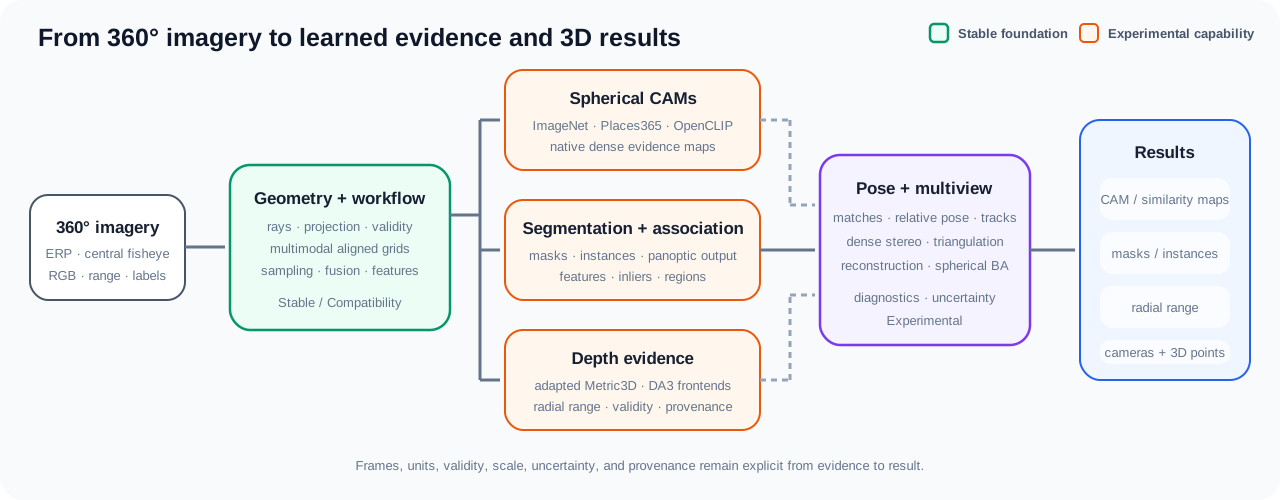
How spherical images are handled
The execution domain is a mathematical choice; it is independent from whether the implementation is Python, NumPy, OpenCV, or first-party C++.
Execution domain |
What happens |
Best suited to |
Output |
|---|---|---|---|
Sphere-native |
PanorAi works with unit rays, angular neighbourhoods, tangent frames, or spherical residuals without materializing a full planar view |
convolution, gradients, equalization, rotations, bearing geometry, bundle adjustment |
ERP-valued result, bearings, pose, or 3D structure |
Projection-domain |
PanorAi materializes gnomonic/cubemap images and applies an operation in those images |
established planar detectors, descriptors, neural models, and view-local processing |
projected images, or results mapped to ERP/bearings |
Hybrid |
A workflow combines sphere-native stages with small or full projected views |
spherical DoG with tangent SIFT descriptors, face-based features followed by bearing geometry, projection/process/reconstruction |
depends on the workflow |
Neither strategy is universally better. Sphere-native processing preserves a constant angular interpretation across latitude and the longitude seam. Projection-domain processing makes well-tested planar algorithms available in locally low-distortion views. PanorAi’s job is to make the chosen route and its coordinate transformations explicit.
Projection
What you can do with projection
Use canonical pixel-centre geometry to convert ERP pixels, gnomonic pixels, cubemap pixels, and unit rays. Materialize one view or a batch, process views, and reconstruct an ERP with explicit support and validity. The result is useful on its own and is also the foundation for features, learned models, and camera geometry.
Typical input → result: ERP/rays/projected images → views, bearings, or ERP.
Start here: Projection foundations: sphere, rays, views, samplers, and blenders; use Quick start for the shortest path and Cubemap, batch, and autograd for batched processing.
Capability |
Public entry point |
Execution domain |
What PanorAi adds |
|---|---|---|---|
ERP pixels ↔ rays |
|
Sphere-native coordinates |
Canonical |
ERP ↔ one tangent view |
|
Projection-domain |
Forward/inverse geometry, FOV and roll, seam-aware sampling, support and validity |
ERP ↔ cubemap |
|
Projection-domain |
Fixed face order/bases and deterministic edge/vertex ties |
ERP ↔ arbitrary view set |
|
Projection-domain |
Face provenance, modality-aware sampling, inverse projection, explicit-support blending |
Process and reconstruct |
|
Projection-domain |
ERP → views → caller operation → backprojection → blend orchestration; the caller owns the view-local operation |
Lift point detections |
|
Projection-domain + spherical mapping |
Face pixels → ERP pixels and unit bearings, with provenance and deterministic angular NMS |
Lift regions |
|
Projection-domain + spherical mapping |
Boxes/polygons → bearing boundaries; masks → compact ERP masks; solid-angle NMS and merge |
Aggregate whole-view evidence |
|
Hybrid |
Face footprints, overlap-normalized solid-angle scores, and explicitly normalized embeddings |
Batched differentiable projection |
Torch gnomonic/cubemap APIs |
Projection-domain |
|
Sphere sampling layouts |
cube, icosahedron, Fibonacci, and Compatibility samplers |
Sphere-native planning |
View centres/FOVs in the canonical spherical frame; a raster exists only when projection is requested |
Blending |
average, feather, Gaussian, closest, Huber, and research blenders |
Hybrid reconstruction |
Combines already backprojected ERP layers using explicit masks; zero/black remains valid data |
RGB, range, labels, masks, CAM/logits |
typed raster-field workflow |
Projection-domain |
Radial range stays radial; categories use nearest; continuous channels declare components; support and validity remain separate |
Quick start and object workflow
The functional and object APIs share the same geometry. project materializes
a gnomonic image; back_project reverse-maps it onto explicit ERP support.
process_views is therefore a projection-domain workflow, even if the caller
uses a filter whose name resembles a spherical operation. Use a
panorai.image_processing spherical function instead when the desired
neighbourhood must remain angularly constant everywhere.
Cubemap, batch, and learned-model workflow
Cubemap and arbitrary-N views are first-class outputs. A model can operate on those images and PanorAi can reconstruct its predictions into ERP. PanorAi owns the projection, geometry, masks, and fusion; the caller or model owns the semantics of the projected-image operation.
Image processing
What you can do with image processing
Apply familiar OpenCV-style filtering concepts with angular rather than raw ERP-pixel neighbourhoods. The current image-processing API is sphere-native: it does not split the panorama into gnomonic tiles and stitch the result.
Typical input → result: ERP image → filtered, enhanced, transformed, edge, or pyramid ERP data.
Start here: Tutorial: image processing on the sphere.
Capability |
Public entry point |
Execution domain |
What PanorAi adds |
|---|---|---|---|
General 2D correlation |
|
Sphere-native spherical convolution |
Kernel taps live in every ray’s local east/north tangent frame, use constant angular spacing, and cross the ERP seam |
Averaging and Gaussian smoothing |
|
Sphere-native spherical convolution |
Angularly consistent support instead of latitude-dependent ERP-pixel support |
First/second derivatives |
|
Sphere-native spherical convolution |
East/north tangent derivatives, magnitude/orientation, and seam-consistent second derivatives |
Median smoothing |
|
Sphere-native nonlinear neighbourhood |
Median over a sampled geodesic tangent neighbourhood |
Bilateral smoothing |
|
Sphere-native nonlinear neighbourhood |
Angular spatial weights plus radiometric weights |
Edge detection |
|
Sphere-native hybrid of convolution and nonlinear stages |
Spherical Gaussian/gradients followed by geodesic suppression and seam-connected hysteresis |
Histogram equalization |
|
Sphere-native global statistics |
Optional solid-angle weighting avoids over-counting the dense ERP polar rows |
Superpixels |
|
Sphere-native iterative clustering |
Concentrated-local geodesic/Lloyd seeds, rotation-covariant textured seeds, an equal-area uniform fallback, great-circle spatial distance, solid-angle centroid updates, and seam-periodic connectivity |
Rotation |
|
Sphere-native direct ray sampling |
Inverse maps output rays through a proper 3×3 rotation, with no artificial image border |
Resize |
|
Sphere-native direct ray sampling |
Samples exact output ERP pixel-centre rays and treats longitude as periodic |
Gaussian pyramid |
spherical Gaussian pyramid API |
Sphere-native convolution plus direct ray resizing |
Angular prefiltering before each scale change |
Laplacian pyramid |
spherical Laplacian pyramid/reconstruction API |
Sphere-native convolution plus direct ray resizing |
Sphere-aware residual levels with tested reconstruction |
This distinction matters: linear convolution, nonlinear neighbourhood filters, global histogram statistics, and geometric transforms are all sphere-native, but only the linear kernel stages are spherical convolution.
Features and matching
What you can do with features and matching
Extract local features from a panorama, deduplicate overlap geometrically, match descriptors, and obtain correspondence pairs as unit bearings. Choose a stable projection-domain frontend or the Experimental sphere-native DoG detector according to where keypoint selection must happen.
Typical input → result: one/two ERPs → spherical feature sets, descriptors, matches, and paired unit bearings.
Start here: Tutorial: spherical features and matching; see Spherical features and matching for task-oriented recipes.
Capability |
Public entry point |
Execution domain |
What PanorAi adds |
|---|---|---|---|
Stable SIFT/ORB/AKAZE frontend |
spherical feature façade with |
Projection-domain detection and description |
Overlapping gnomonic views, masks, mapping back to ERP pixels/unit bearings, angular deduplication, provenance |
Spherical DoG + SIFT |
|
Hybrid: sphere-native Gaussian/DoG detection, one local tangent patch per descriptor |
Seam-aware keypoint selection, angular scale, tangent orientation, and standard spherical result objects |
Descriptor matching |
BF/FLANN through the spherical matcher |
Descriptor-domain, then sphere-native correspondence handling |
Match provenance, angular deduplication, and aligned bearing pairs |
Multiscale visual context |
Experimental wide/local view routing |
Projection-domain frontend, sphere-native deduplication |
Explicit scale/view provenance and spherical NMS |
COLMAP export |
PyCOLMAP export adapter |
Projection-domain virtual-camera representation |
Consistent gnomonic camera rigs and feature/match export |
PanorAi does not reimplement the SIFT descriptor. In the Experimental route, PanorAi detects DoG extrema on a spherical scale space and materializes only a small tangent patch at each selected bearing; OpenCV computes the SIFT descriptor on that patch. In the stable route, both detection and description happen in overlapping gnomonic views.
Registration and stitching
What you can do with overlapping planar captures
Use PanoramaStitcher to detect and match evidence, estimate missing shared
horizontal FOV when observable, recover a connected set of SO(3) camera
orientations, warp every source to ERP and fuse valid contributions. The
Application is a convenience over public calibration, model-fitting and
Pipeline components.
Typical input → result: two or more overlapping planar pinhole images → partial typed ERP, recovered camera geometry and diagnostics.
Start here: Registration and panorama stitching.
Stage |
Public entry point |
Domain |
Current boundary |
|---|---|---|---|
Feature evidence |
|
planar sources |
masked SIFT or ORB |
Overlap discovery |
|
descriptor pairs |
symmetric ratio-tested matching |
Calibration and registration |
|
pixels → pinhole rays → SO(3) |
centred pinhole model; known or observable shared horizontal FOV |
ERP warp |
|
camera rays → ERP |
values, support and validity transformed independently |
Photometric compensation |
|
valid ERP overlap |
none or one positive gain per image |
Fusion |
|
aligned ERP contributions |
average or feather; no seam finder or multiband blend |
The first image defines the world gauge. Translation, strong parallax, rolling shutter, disconnected overlap, fisheye distortion and unobservable FOV must fail rather than acquiring plausible but unsupported geometry.
Two-view geometry
What you can do with two views
Turn matched panorama features into a relative camera pose without pretending that ERP pixel coordinates belong to a pinhole camera. The estimator consumes unit bearings, scores hypotheses with spherical residuals, checks cheirality, and reports degeneracy diagnostics.
Typical input → result: paired unit bearings → panorama-frame rotation, unit translation direction, inliers, quality diagnostics, and arbitrary-scale triangulated points.
Start here: Tutorial: spherical Essential matrix and two-view triangulation.
Stage |
Public entry point |
Execution domain |
What PanorAi adds |
|---|---|---|---|
Correspondence adapter |
matched spherical feature rows → bearing pairs |
Sphere-native coordinates |
Removes all virtual-face pixel frames before geometry |
Essential pose |
relative-pose estimator |
Sphere-native bearing geometry |
Five-ray hypotheses, tangent-Sampson scoring, refinement, cheirality, quality and degeneracy reporting |
Triangulation example |
tutorial helper, not public API |
Sphere-native bearing geometry |
Demonstrates the canonical frame, positive depth, and arbitrary-scale convention |
No projected image is required after the frontend has produced unit bearings. If features came from gnomonic views, the complete workflow is hybrid: view projection for local evidence, then sphere-native two-view geometry.
Multiview reconstruction
What you can do with multiple views
Connect pairwise matches into a view graph and conflict-free tracks, initialize camera rotations/positions and 3D points, then jointly optimize spherical reprojection residuals. Failures are represented explicitly instead of being hidden behind partial maps.
Typical input → result: features and matches from 3+ panoramas → optimized panorama poses, sparse 3D points, observations, and diagnostics at arbitrary global scale.
Start here: Tutorial: from matched panoramas to a multiview reconstruction; see Estimate spherical pose and reconstruct multiple panoramas for operational recipes.
Stage |
Public entry point |
Execution domain |
What PanorAi adds |
|---|---|---|---|
Pair graph |
reconstruction builder/mapper |
Sphere-native bearing geometry |
Quality-gated pose edges with accepted/rejected reasons and panorama identity |
Tracks |
multiview track construction |
Sphere-native observation graph |
Conflict-free tracks with at most one observation per panorama |
Initialization |
reconstruction mapper |
Sphere-native bearing geometry |
Panorama-frame pose initialization, point triangulation, and explicit gauge conventions |
Bundle adjustment |
spherical reconstruction options/mapper |
Sphere-native optimization |
Tangent-plane log-map residuals between predicted and measured bearings, filtering, Jacobians, and diagnostics |
COLMAP alternative |
PyCOLMAP export |
Projection-domain virtual cameras |
PanorAi owns export geometry; PyCOLMAP/COLMAP owns the downstream reconstruction |
The native PanorAi mapper never reconstructs ERP images during optimization. Its output is geometry. The COLMAP alternative intentionally uses a projected virtual-camera rig because that is the external tool’s camera model.
Spherical dense stereo
What you can do with two posed panoramas
Estimate radial range directly on the ERP lattice from two central panoramas and a metric relative pose. Inverse-range hypotheses follow spherical epipolar curves; no full gnomonic image set is materialized.
Typical input → result: two aligned ERP panoramas plus metric $R,t$ → radial range, validity, confidence, cost, and hypothesis-index maps.
Start here: Tutorial: dense stereo from two spherical images; see Direct spherical dense stereo: geometry and optimization for the objective and limitations.
Stage |
Public entry point |
Execution domain |
What PanorAi adds |
|---|---|---|---|
Plane sweep |
|
Sphere-native bearing/range geometry |
Pose-driven spherical epipolar hypotheses and seam-safe ERP sampling |
Adaptive range pyramid |
|
Sphere-native coarse-to-fine range search |
Broad absolute inverse-range sweep followed by uncertainty-aware normalized local offsets; supplied high-resolution $R,t$ is unchanged |
Appearance normalization and gradients |
|
Sphere-native tangent neighbourhoods |
Angular box support and east/north derivatives instead of rectangular ERP filters |
Local cost filtering |
dense stereo estimator |
Sphere-native spherical convolution |
Constant angular support across latitude; C++/NumPy parity through the image-processing contract |
Path aggregation and consistency |
dense stereo estimator |
ERP optimization over spherical evidence |
Four edge-aware paths, sub-hypothesis refinement, explicit validity and bidirectional checks |
OpenCV supplies the bilinear and nearest remapping primitive. The local filters use PanorAi spherical convolution directly; they do not project to gnomonic views and reconstruct an ERP.
SLAM
What you can do with SLAM
Estimate an online trajectory from a central ERP or calibrated central-fisheye sequence, select keyframes, create and optimize a local map, relocalize, and apply loop corrections. PanorAi exposes status and diagnostics alongside the pose so tracking failures are inspectable.
Typical input → result: ordered central-camera frames or caller-provided spherical feature sets → per-frame pose/status, keyframes, map observations, loop information, and an arbitrary-scale trajectory.
Start here: Tutorial: spherical visual SLAM; see Run spherical visual SLAM for configuration and lifecycle details.
Workflow |
Public entry point |
Execution domain |
What PanorAi adds |
|---|---|---|---|
ERP incremental SLAM |
|
Hybrid: default gnomonic feature frontend, then sphere-native tracking/mapping |
Central panorama bearings, immediate status/pose, keyframes, spherical 2D–3D refinement, local BA, relocalization and loop correction |
Precomputed feature route |
|
Sphere-native after caller-owned features |
Skips image projection while retaining feature, match, pose, and map contracts |
Calibrated central-fisheye SLAM |
|
Hybrid: OpenCV features on the physical fisheye image, calibrated ray inversion, then sphere-native graph/reconstruction |
Equidistant calibration, central-camera bearings, graph diagnostics, and arbitrary-scale trajectory |
Dual-fisheye input |
explicit validation |
Not modeled as one central sphere |
Rejects the invalid assumption that two physical camera centres are one central camera |
SLAM produces camera and map geometry, not a filtered or reconstructed ERP. Its spherical specificity comes from calibrated unit bearings and tangent-space residuals after the image frontend has produced observations.
Spatial-semantic graph
What you can do with prepared multimodal evidence
Associate feature-indexed semantic regions across views, estimate angular, scale-free, or metric spatial support, maintain conservative entity lifecycle and lineage, persist a deterministic snapshot, and query it with decomposed scores and evidence provenance.
Typical input → result: explicit views, regions, matches/inliers, pose, and optional depth/scale → replayable spatial-semantic graph.
Start here: Build and query a spatial-semantic graph.
Stage |
Public entry point |
Boundary |
|---|---|---|
Evidence declaration |
|
Records modality, frame, units, split, access role, calibration, provenance, and correlation group |
Pair association |
|
Reuses pose-supporting features and inliers; optional rematching cannot rewrite pose |
Pair localization |
|
Localizes exactly one region pair and creates no persistent identity |
Entity lifecycle |
|
Consumes results only; one view cannot confirm an entity; merge/split retain lineage |
Persistence and query |
JSONL/NPZ archive and |
Content-addressed arrays, checksum validation, explicit encoder/frame/unit compatibility |
The graph is not an end-to-end perception facade. Applications explicitly invoke their providers, inspect the results, and decide which method-usable evidence enters the builder. Evaluation-only evidence fails closed.
C++ acceleration is a separate axis
Sphere-native versus projection-domain describes the mathematics. C++ versus NumPy/Python/OpenCV describes execution. A native kernel does not turn a projected algorithm into a spherical one, and a NumPy implementation can still be fully sphere-native.
Area |
Mathematical route |
C++ acceleration |
Reference/fallback |
Effect on semantics |
|---|---|---|---|---|
Projection |
Projection-domain |
First-party fused arbitrary-N ERP → gnomonic sampling, selective bilinear cubemap → ERP, and compatible Gaussian view reconstruction |
NumPy engine; Torch has its own differentiable route |
None: same coordinates, interpolation, masks, and result contract |
Image processing |
Sphere-native |
First-party |
NumPy spherical sampler selected with |
None: same angular taps and output layout |
Experimental deep learning |
Sphere-native learned neighbourhoods |
Differentiable Torch spherical |
Direct ports preserve external parameters; transformed upsamplers and planar/cubemap controls remain explicit |
Porting preserves declared provenance and output lattice, not perspective-domain calibration or spherical invariance |
Dense stereo local evidence |
Sphere-native |
The same first-party spherical-convolution kernel accelerates local normalization, east/north gradients, and batched cost-volume filtering with hypotheses as channels |
NumPy route via |
None: the range search, angular support, and result contract are unchanged |
Features/descriptors |
Projection-domain or hybrid |
OpenCV’s C++ implementation provides SIFT/ORB/AKAZE, BF, and FLANN; it is not a PanorAi native kernel |
PanorAi orchestrates geometry and spherical metadata |
OpenCV owns descriptor/detector semantics; PanorAi owns mapping and provenance |
Two-view geometry |
Sphere-native |
First-party five-point polynomial coefficients and tangent-Sampson residual kernels |
NumPy path via |
None: same estimator policy and result model |
Multiview reconstruction |
Sphere-native |
First-party spherical-BA residual and local Jacobian blocks |
NumPy/SciPy path via |
None: same tangent residual and optimization contract |
SLAM |
Hybrid |
Reuses accelerated frontend, estimator, and bundle-adjustment components when their conditions apply; no separate native SLAM engine |
Python orchestration over the same component contracts |
None: backend choice does not redefine the SLAM model |
"auto" selects an available compatible first-party native path where that
public option exists. Explicit NumPy modes are useful for reference testing;
native and reference paths are expected to satisfy the same public numerical
contract.
Responsibility and stability boundary
PanorAi owns spherical coordinates, projection, sampling, support/validity, angular neighbourhoods, view orchestration, unit-bearing conversion, spherical residuals, provenance, and result objects. OpenCV owns its detector, descriptor, and matcher implementations. A caller-supplied model owns its inference semantics. PyCOLMAP/COLMAP owns reconstruction after export.
The geometry and face-based feature core are Stable unless the API reference says otherwise. Spherical image processing, spherical DoG, relative pose, deep-learning portability, native multiview reconstruction, multiscale routing, SLAM, and the spatial-semantic graph are currently Experimental. Consult API stability in 3.x before treating an Experimental signature as a long-term compatibility contract.