Tutorial: from matched panoramas to a multiview reconstruction
Field |
Contract |
|---|---|
Application |
Reconstruct and navigate |
Input |
Three or more registered feature/match sets |
Output |
Camera poses, sparse points, tracks, and diagnostics |
Strategy |
Hybrid frontend; sphere-native optimization |
API |
|
Stability |
Experimental |
Dependencies |
Core; feature and PyCOLMAP routes optional |
Evidence |
Method diagram plus analytic/integration fixtures |
How this application is composed
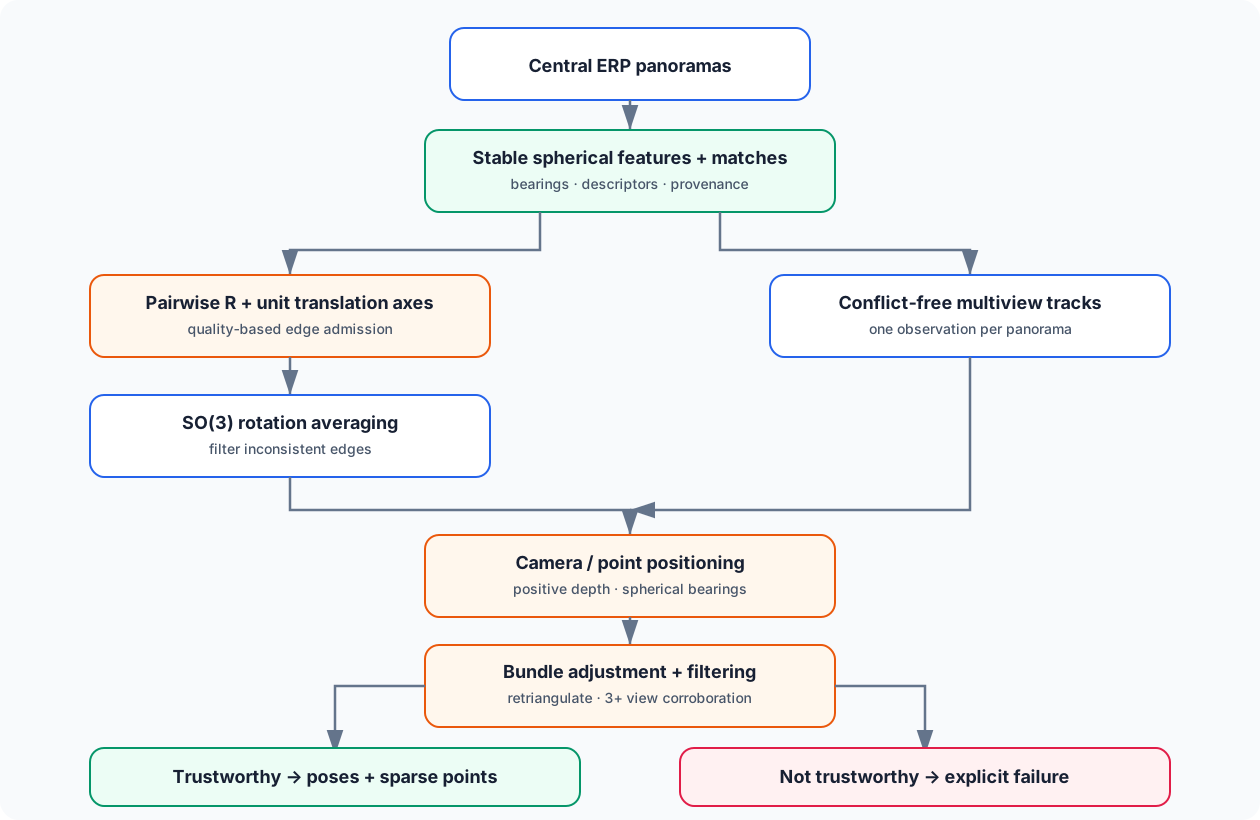
SphericalGlobalMapper composes feature matches, pairwise relative-pose
estimation, conflict-free bearing tracks, rotation averaging, camera/point
initialization and spherical bundle adjustment. These stages reuse geometry
and observation contracts from the core, but the wrapper is the supported
application entry because gauge handling, admission rules and failure reports
cannot be represented by a short chain of array operators.
Two views estimate one relative pose. Three or more overlapping central panoramas let observations form tracks, rotations become globally consistent, and camera centers and points can be optimized together.
See the Multiview reconstruction theme in the spherical computer-vision guide. The PanorAi mapper optimizes bearings, poses, and points directly; “tangent residual” here is a local geometric error coordinate, not a spherical image convolution or a gnomonic image round trip.
PanorAi-specific: panorama-frame pose graphs, conflict-free bearing tracks, spherical bundle-adjustment residuals, arbitrary-scale gauges, corroboration and explicit reconstruction failures.
panorai.reconstruction is an Experimental, arbitrary-scale mapper. Its
failure result is part of the design: insufficient or inconsistent geometry
must not become fabricated camera poses.
1. The reconstruction graph
The public camera convention is
$$ \mathbf x_i = R_i(\mathbf X-\mathbf C_i), $$
where $R_i$ is rotation_world_to_panorama and $\mathbf C_i$ is
center_world. The reference camera fixes the global frame. A depth/scale
anchor fixes only the numerical gauge; it does not create metric scale.
2. Build pairwise evidence with stable IDs
from panorai.features import SphericalFeaturePipeline

pipeline = SphericalFeaturePipeline.for_relative_pose()
panoramas = {"p0": pano0, "p1": pano1, "p2": pano2}
validity = {"p0": valid0, "p1": valid1, "p2": valid2}
pairs = (("p0", "p1"), ("p1", "p2"), ("p0", "p2"))
pairwise_matches = [
    pipeline.extract_and_match(
        panoramas[a],
        panoramas[b],
        panorama_id_a=a,
        panorama_id_b=b,
        validity_mask_a=validity[a],
        validity_mask_b=validity[b],
    )
    for a, b in pairs
]
IDs are not decoration: they let pairwise observations of the same panorama join into conflict-free tracks. In production, select pairs using capture order, retrieval, or known overlap rather than constructing every possible pair blindly.
3. Run the PanorAi mapper
from panorai.reconstruction import SphericalGlobalMapper

mapper = SphericalGlobalMapper()
result = mapper.reconstruct(matches=pairwise_matches)
if not result.success:
    raise RuntimeError(result.failure_reasons)

pose_p1 = result.pose("p1")
R_world_to_p1 = pose_p1.R
center_p1_world = pose_p1.center
points_world = result.points_xyz
assert result.scale == "arbitrary"
If pairwise estimation is expensive and should be reused:
edges = mapper.estimate_pairwise(pairwise_matches)
result = mapper.reconstruct(edges=edges)
Exactly one of matches= and edges= is accepted. The executable
insufficient-geometry contract is:
from panorai.reconstruction import SphericalGlobalMapper

mapper = SphericalGlobalMapper(relative_pose_estimator=pose_estimator)
insufficient = mapper.reconstruct(
    matches=(), panorama_ids=("pano-a", "pano-b", "pano-c")
)
assert not insufficient.success
assert insufficient.points_xyz.shape == (0, 3)
assert insufficient.failure_reasons
4. Understand the stages
Edge admission. By default, only pairwise poses accepted by their quality report enter the graph.
Rotation averaging. Relative rotations are reconciled on $SO(3)$; bad edges can be filtered before translation is trusted.
Tracks. Descriptor matches are unioned only when a component contains at most one observation from each panorama.
Positioning and triangulation. Camera centers and point depths are initialized from spherical bearings and translation axes with positive-depth constraints.
Spherical bundle adjustment. The residual is the two-dimensional tangent-plane log map between measured and predicted bearings.
Filtering and retriangulation. Weak tracks and angular outliers are removed, then geometry is solved again.
Multiview corroboration. An independent solve using tracks observed in at least three panoramas must agree with the primary camera-center directions.
A first-party C++ kernel can evaluate bundle residuals and analytic Jacobian blocks. NumPy/SciPy still own the readable reference, graph policy, robust optimization, filtering, gauges, provenance, and result construction.
5. Add per-photo tripod heights as one global metric prior
Do not estimate and apply an independent scale to every pair. That produces incompatible loops. Instead, first build one arbitrary-scale connected map, then introduce a shared floor plane and one height $h_i$ for every camera center $\mathbf C_i$:
$$ \mathbf g^T\mathbf C_i=h_i, \qquad \mathbf g^T\mathbf X_j=0\quad\text{for verified floor tracks }j. $$
The floor tracks connect the metric plane to the visual reconstruction. If all heights are equal but no observation is known to lie on the floor, the camera centers are merely constrained to one horizontal plane and the horizontal map scale remains free. With verified floor tracks, one shared similarity scale can be estimated robustly and then refined together with cameras and points.
For a practical first implementation:
estimate rotations, translation directions and tracks exactly as today;
estimate a common up direction from trusted levelling/IMU metadata;
label floor observations and intersect well-conditioned rays using their camera’s measured optical-center height;
fit one global positive scale from all floor observations, rejecting near-horizon and inconsistent samples;
rerun spherical bundle adjustment with camera-height and floor-plane residuals, keeping measurement tolerances explicit;
report both metric residuals and the existing angular reprojection metrics.
This metric extension is not currently a public SphericalGlobalMapper option.
The existing mapper remains Experimental and correctly reports
result.scale == "arbitrary".
6. Inspect before consuming the map
At minimum inspect:
pairwise accepted/rejected edges and all rejection reasons;
rotation- and translation-filtered edges and translation sign flips;
active tracks per panorama and track lengths;
positive-depth and triangulation-angle support;
angular reprojection median/P90/P95;
multiview corroboration status and disagreement;
excluded panoramas, gauges, backend, and
failure_reasons.
The current promotion decision is negative. In the latest recorded 423-set metadata-blind census, the conservative mapper produced 131 complete maps and all 131 met the strict accuracy criterion, but coverage remained only 31.0%. That is strong selective precision and insufficient unattended reliability. The surface therefore remains Experimental and applications need explicit failure/recapture behavior.
7. PanorAi mapper or PyCOLMAP/COLMAP?
Need |
Recommended route |
|---|---|
inspect PanorAi-owned spherical equations and diagnostics |
|
use a mature general SfM lifecycle, image registration, and established tooling |
build a virtual rig and export to PyCOLMAP/COLMAP |
compare methods |
freeze the same features/matches and record each system’s frames and gauges |
The PanorAi mapper does not call OpenCV, PyCOLMAP, or COLMAP for geometry. The optional exporter writes known gnomonic cameras, features, and matches; COLMAP then owns registration, triangulation, bundle adjustment, and its own result conventions. Export remains Experimental.
See Estimate spherical pose and reconstruct multiple panoramas for the concise recipe and Global spherical reconstruction for every option, frame, diagnostic, native backend, and known limitation.